Experiencing a Cybersecurity Incident? Get Help Now. | Abacus Group and Medicus IT have merged. Learn more.
Experiencing a Cybersecurity Incident? Get Help Now.
Abacus Group and Medicus IT have merged. Learn more.





In 2025, the Abacus Group incident response team responded to 100+ breaches, helping recover organizations impacted by a cyberattack. What defined those engagements wasn't the AI-driven threats, nation-state campaigns, or sophisticated ransomware-as-a-service operations that have dominated headlines; it was the same foundational techniques attackers have relied on for years: stolen credentials, unprotected remote access, and the persistent underestimation of how quickly a single entry point can escalate into a full environment compromise.
Organizations are investing in IT and cybersecurity more than ever, internal teams are expanding, and security awareness at the executive level is genuinely at a high-water mark. In a 2025 survey of 1,100 security leaders, half said they were “very well prepared” for ransomware. Yet 78% still reported being hit in the past year. That isn't negligence; they were responding to the threat landscape as the industry has framed it. But while media attention concentrated on the most novel and sophisticated attack methods, global ransomware surged 32%, reaching a record 7,419 recorded cases, driven overwhelmingly by the foundational exposures that never commanded the same focus.
For regulated firms, this distinction matters enormously. The threat is real and growing, but the path to resilience is often more straightforward than the discourse suggests.
Ransomware actors have become deliberate in how they select targets, and regulated industries, like financial services and healthcare, share a common threat profile that makes them consistently attractive. They hold data that is exceptionally sensitive, they face strict breach notification requirements and regulatory consequences that extend well beyond the incident itself, and they operate in environments where prolonged downtime carries real operational, legal, and reputational stakes. That pressure changes decision timelines, and threat actors count on it. Our own 2025 engagement data shows healthcare as the single largest sector by volume, a pattern driven not by chance but by how attackers now calculate risk and reward.
There is no question that AI is reshaping the threat landscape. Adversaries are using it to automate reconnaissance, generate convincing phishing content, and compress what used to be days of lateral movement into hours. In 2025, 76% of security professionals reported that attacks are outpacing their ability to respond, and nearly half said they doubt their teams can detect and contain AI-driven intrusions at the speed they now execute. The sophistication of what happens after initial access—the speed of lateral movement, the precision of the extortion demand—has absolutely increased.
But the door being opened is still, overwhelmingly, a familiar one. In the 2025 incidents and breach datasets, initial access was still dominated by identity; attackers weren’t ‘breaking in’ so much as logging in.
The attack vectors most frequently observed in 2025 tell that story clearly:
| Attack Vectors | What It Looks Like |
| Stolen Credentials (VPN/RDP) | Valid logins obtained via phishing, credential stuffing, or purchase on dark web marketplaces, used to walk straight into the environment |
| Social Engineering / Help Desk Attacks | Calling support staff to reset passwords or bypass MFA; increasingly aided by AI-generated voice and contextual phishing |
| Vulnerability Exploitation | Known flaws in VPN appliances, remote monitoring tools, and enterprise software exploited before patches are applied |
| Supply Chain & Cloud Abuse | Compromising trusted SaaS vendors or integrations to reach the primary target indirectly |
| Shared Infrastructure | Domain-joined hypervisors, backup systems, and security tools leveraged to disable defenses and detonate payloads quickly |
The ecosystem behind ransomware has become a crowded, fast-moving marketplace. In 2025, researchers tracked a record 124 distinct ransomware groups, a 46% increase year over year, with the leaderboard shifting constantly as newer operations scaled and older ones rebranded. Qilin was among the most prolific groups observed, with Akira close behind.
Modern ransomware operates like a supply chain. Access brokers specialize in obtaining a foothold, and affiliates carry out the intrusion and deployment under a ransomware program in exchange for a cut of the proceeds. When one operation gets disrupted, the volume doesn't disappear; it reorganizes. Affiliates migrate, tooling gets repackaged, and the same playbooks resurface under new names, sometimes within weeks.
That structure is also why the speed problem is compounding. Attackers are compressing the timeline from initial access to enterprise-wide impact, leaving defenders with a shrinking window to respond. In CrowdStrike’s 2025 Ransomware survey, 76% of organizations reported struggling to match the pace of AI-augmented attacks. If your incident response plan assumes you'll have time to assemble and orient, you're already behind.
In a market that rewards speed, the first few hours matter far more than the logo on the ransom note.
Confirmed Breaches Listed by Threat Actor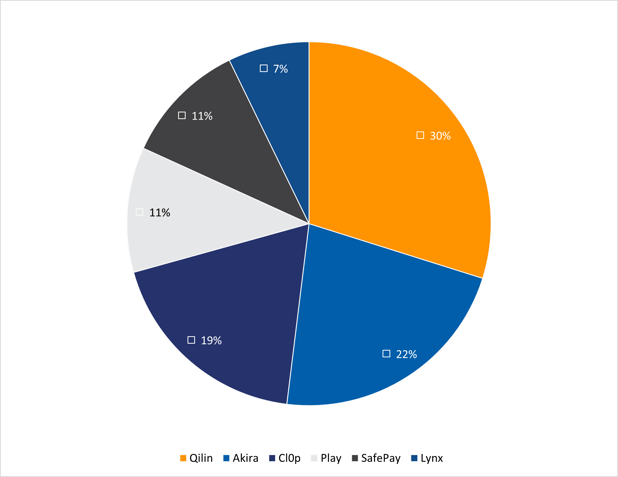
The organizations that fared best in 2025 weren't necessarily the most advanced; they were the ones that had closed their most exploited exposure points and had a clear plan for when something went wrong. Based on what our team saw across engagements last year, our top recommendations to organizations in 2026 include:
The 2026 threat landscape will be faster and more automated than what we saw in 2025, but the path to resilience hasn't shifted as dramatically as the headlines suggest. Closing identity gaps, pressure-testing recovery before you need it, and having an incident response plan that your team has actually rehearsed: those are still the fundamentals that separate firms that recover in days from those that recover in weeks.
Abacus Group's cybersecurity and advisory teams help clients in highly regulated industries, like financial services and healthcare, combat evolving cyber threats through proactive action. Whether you're looking to assess your current posture or pressure-test your IR readiness, we're here to help. Connect with the team.
.png)